Abutment The junction of a roof surface with a wall, or any other structural feature, which arises above it
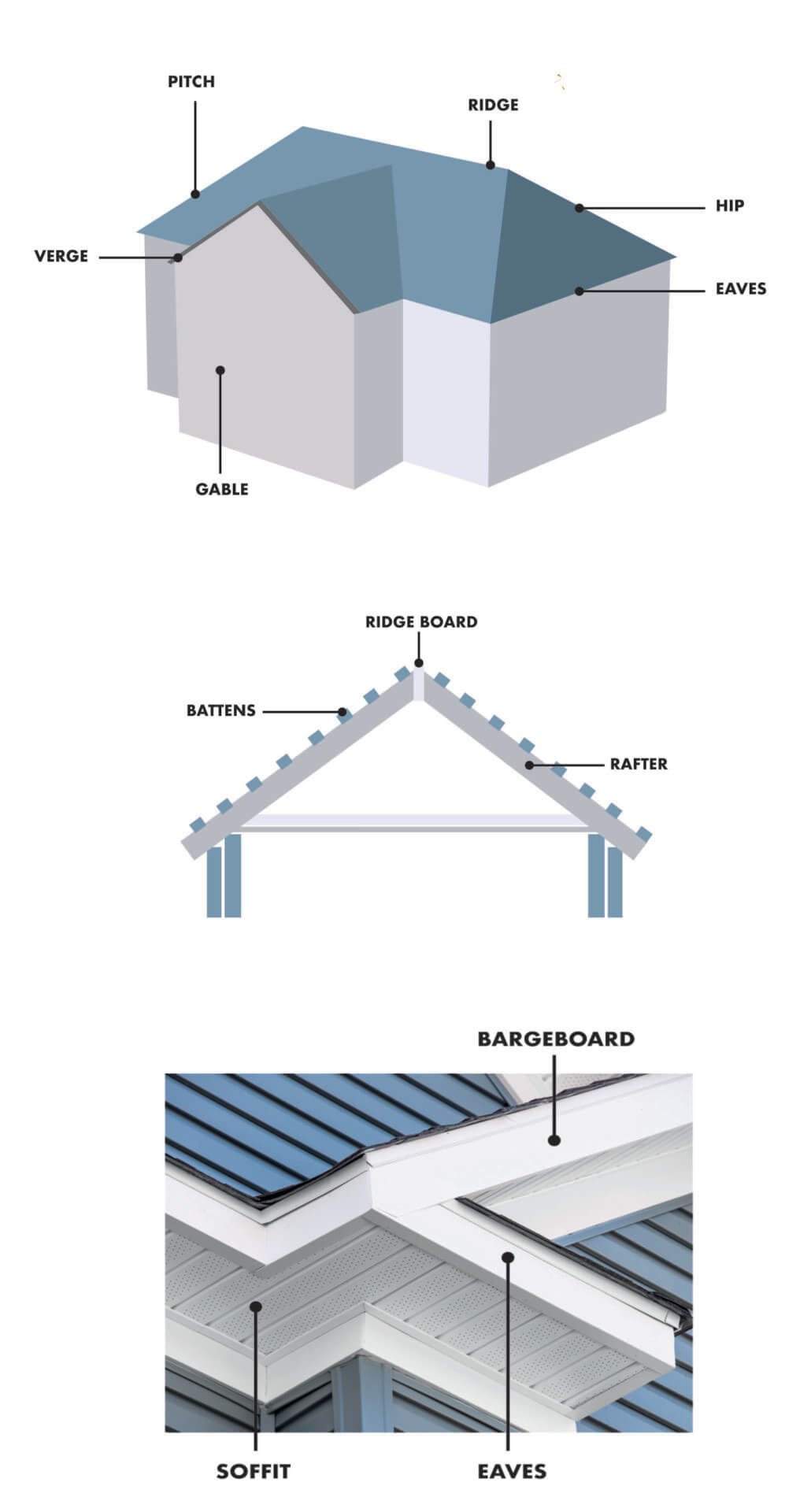
Barge Board A board fixed along the edge of a gable
Batten Horizontal small section timbers that are nailed to the rafters and to which tiles/slates are secured
Back Gutter A gutter formed in lead at the back of a chimney, or any other structure, which penetrates the roof to disperse water onto tiles/slates
Cold Roof A roof that has insulation laid horizontally at ceiling level and a void between the insulation and its outer roof structure and covering
Course A horizontal row of tiles or slates
Dormer Framed window unit, which projects through the sloping plane of a roof
Down Pipe Pipe which takes water away from guttering to drains
Eaves The horizontal, lower edge of a sloped roof – where the first course of tiles/slates are laid on the fascia board
Fascia Board The horizontal timber trim attached vertically at the eaves that covers the rafter ends, the wall plate or the wall face – the guttering is fixed to this and upon which the first course of tiles/slates are laid
Felt/Underlay Breather membrane untearable bituminous or PVC sheet material, supplied in rolls and laid over rafters
Flashing Strip of lead, used at abutments, to stop water penetration, The ‘Code’ of lead means the thickness
Gable The upper portion of a sidewall, which comes to a triangular point at the ridge of a sloping roof
Gauge The length of tile/slate exposed after it has been installed. It equals the distance between the top of one batten and the top of the next
Gutter The trough that channels water from the eaves to the down pipes
Headlap The amount by which a tile/slate overlaps the course below it
Hip The meeting of two pitched roof surfaces, which meet at an external angle
Hip Iron A metal hook, which is secured to the roof structure to support the hip tiles and stop them from slipping
Mortar Sand and cement mix consisting of 3 parts sand to 1 part cement
Parapet Low protective wall that extends above the roofline for support
Pitch Also known as ‘slope’, is the measure of how steep a roof is. The pitch of a roof is a big factor in determining the kinds of materials that can be used and the longevity of the roof. Usually, a steeper roof will last longer due to its better draining capabilities
Purlin Main structural roof support timber: usually situated half way up the roof span: to which rafters are nailed
Rafter The supporting framing timber, sloping from ridge to wall plate
Raking Cut A diagonal cut across courses of tiles/slates
Ridge The uppermost horizontal junction of two slopes forming the apex of a pitched roof
Saddle A piece of impervious flexible sheet material (usually lead) dressed to shape, fitted to provide weather protection
Secret Gutter A gutter formed at an abutment and effectively hidden from sight
Soaker A small piece of sheet (usually lead), shaped and inserted between the roof covering and the sub-structure (see felt)
Soffit Board A board fixed to the feet of rafters, which forms the underside of projecting eaves
Undercloak Title or fibre cement strip, fixed at the verge beneath the battens, onto which the verge tiles/slates are bedded
Underlay A layer of material acting as a barrier between the roof covering and the sub-structure (see felt)
Valley The junction of two inclined roof surfaces at an internal angle to provide water run-off; channel to allow roof slopes at different pitches to join together and discharge water into gutters
Valley Gutter A visible gutter running down the valley
Verge A free end of a roof surface; for example that at the end of a gable or dormer
Warm Roof A roof that has insulation and a vapour barrier laid above or between its supporting structure (normally on the pitch of the rafters) and immediately bellow its weatherproof membrane